
AI can create meaningful value across procurement, supply chain, manufacturing, and operations. Realizing that value does not necessarily require replacing the systems, processes, or workflows your teams already rely on.
Often, the opportunity starts by looking at an existing workflow and asking where it could work better.
Where could information move faster? Where could teams spend less time gathering or interpreting data? Where could a decision be accelerated? Where could repetitive work be reduced? Where could AI help someone get to the right information or next action faster?
This is where AI can become especially useful: augmenting and accelerating the way work already gets done while improving the experience around the people, systems, and processes already in place.
A thoughtful approach starts with understanding the workflow well enough to determine where AI can create meaningful value, where traditional automation may be the better fit, where the workflow itself could be improved, and where human expertise should remain central.
If you are evaluating where AI belongs in an existing workflow, these five questions are a useful place to start.
1. What outcome are we trying to improve?
Start with the result.
Maybe the goal is to reduce the time required to evaluate a sourcing opportunity. Improve visibility into supply risk. Accelerate approvals. Reduce repetitive administrative work. Or help teams get to the information they need faster.
The clearer the outcome, the easier it becomes to determine what kind of change will actually help.
A useful question to ask is:
What are we trying to improve, and what is getting in the way today?
That keeps the focus on business value and gives you a stronger starting point for evaluating AI, automation, or process changes.
2. How does work actually happen today?
Most workflows are more complex in practice than they appear on a process map.
Information may move between multiple systems. Different teams may own different parts of the process. Approvals may depend on geography, spend thresholds, customer requirements, business rules, or other conditions.
And there are almost always exceptions. Understanding that operating reality matters because any technology you introduce has to work within it.
Look at the complete workflow and ask:
-
- Who is involved?
- What systems and data sources are used?
- Where does information move between teams?
- What approvals or controls exist?
- Where do delays or manual handoffs occur?
- What happens when the normal process does not apply?
The purpose is to understand what already works, where friction exists, and where there is an opportunity to improve the process without introducing unnecessary disruption.
3. Where are decisions being made?
Workflows are sequences of tasks and decisions. Some decisions are highly repeatable and follow clear rules. Others require interpretation, context, or experience.
That distinction can help determine the right role for AI.
For example, AI may be well suited to helping teams review large amounts of information, compare inputs, identify patterns, summarize findings, or surface what deserves attention.
A decision involving a strategic supplier relationship, significant financial exposure, an unusual operational condition, or a customer commitment may still benefit from human judgment.
The key question is whether technology can make that decision faster, better informed, or easier to execute while maintaining the appropriate level of accountability.
4. Where are people spending time gathering, moving, or interpreting information?
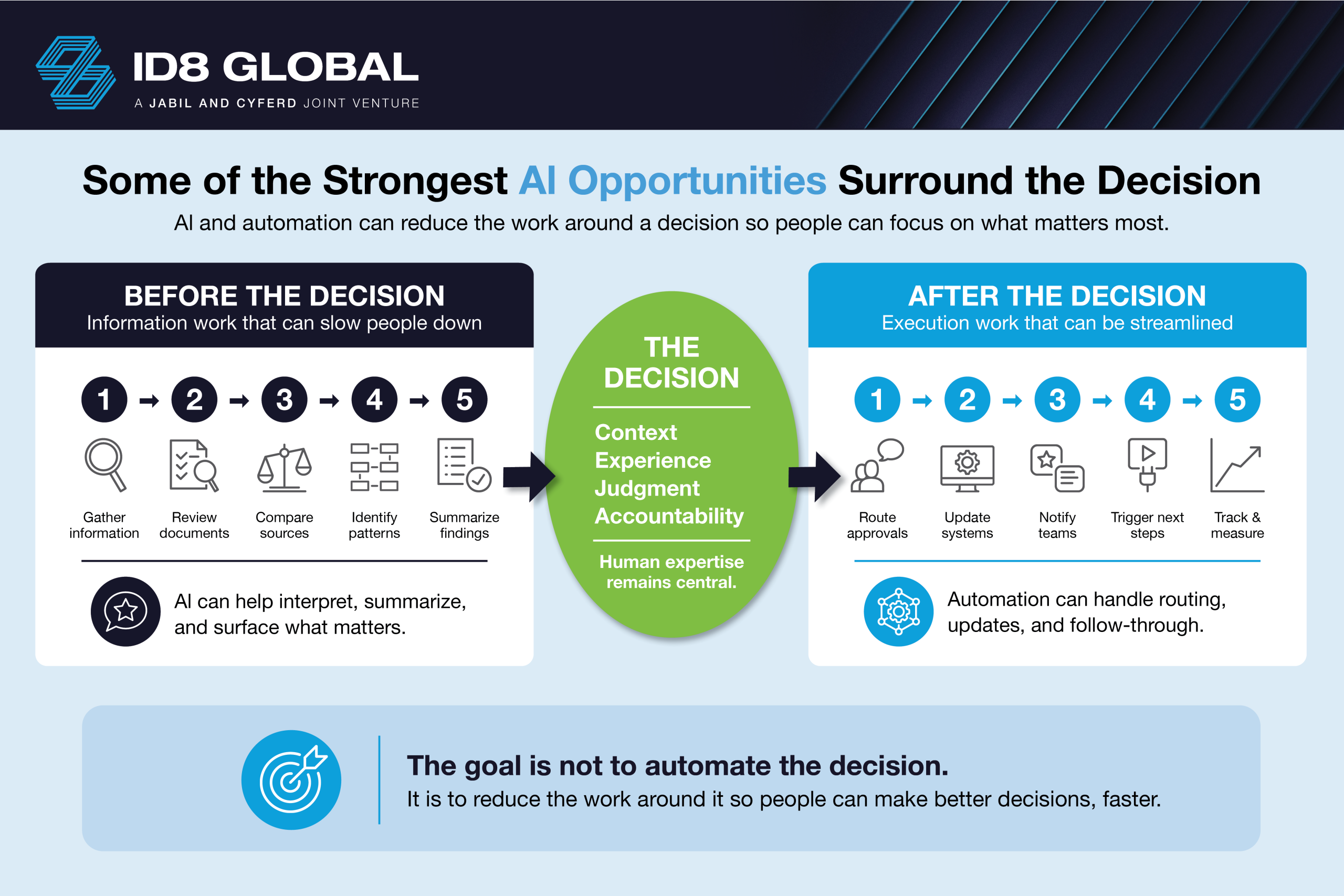
Some of the strongest AI and automation opportunities appear in the work surrounding a decision rather than in the decision itself.
Teams may be spending time:
-
- Collecting information from multiple systems
- Reviewing documents or supplier responses
- Comparing data across sources
- Summarizing large amounts of information
- Moving data between tools
- Preparing information for another team
- Repeating the same administrative steps each time a process runs
These activities can consume significant time without necessarily requiring the same level of expertise as the decision they support.
Different technologies may play different roles here.
AI can help interpret, summarize, or surface information. Automation can handle predictable movement between systems, routing, notifications, or recurring actions.
In some cases, simply redesigning a step in the workflow may remove unnecessary work altogether.
The objective is to reduce the work that slows people down so they can spend more time on the activities where their expertise matters.
5. Where should human expertise remain in the loop?
Human involvement should be an intentional part of workflow design.
Some moments require experience that is difficult to reduce to a rule. Others carry enough consequence that accountability should remain with a person.
Ask where relationships, context, judgment, or operational expertise materially improve the outcome.
That may include decisions involving:
-
- Strategic suppliers
- Significant risk or financial impact
- Unusual exceptions
- Customer commitments
- Regulatory or governance requirements
- Situations where the available data does not tell the whole story
Effective AI-enabled workflows use technology to give people better information, reduce unnecessary manual work, and focus human attention where it creates the most value.
Start with one workflow
Organizations can begin creating value with AI without redesigning their entire operating environment.
A practical starting point is one meaningful workflow.
Choose an area where improving speed, visibility, coordination, or decision-making would create real value. Understand how the work happens today. Identify the decisions. Look for repetitive or information-heavy steps. Determine where technology can help and where expertise should remain central.
The right approach may combine AI, automation, workflow redesign, and human judgment, depending on what the workflow requires.
Start with what is already working, identify where friction exists, and focus technology on the places where it can make the biggest difference.
The goal is better workflows, with AI applied only where it adds real value.
Ready to explore one of your workflows?
A workflow review is a practical way to identify where AI, automation, or process improvements could make an existing workflow more effective.
Bring us one workflow. We’ll help you look at how it works today, where friction exists, and where technology could add the most value.