
El Niño is emerging as an important risk indicator for 2026. Recent climate outlook suggests a shift in tropical Pacific conditions, with sea surface temperature anomalies continuing to rise. This indicates a strengthening warm phase of the El Niño Southern Oscillation, or ENSO.
Model projections and expert assessments suggest an 80% likelihood of El Niño conditions during June, July, and August 2026. ENSO-neutral conditions are estimated at approximately 20% for the same period.
For July through September, August through October, and September through November 2026, El Niño is expected to become firmly established, with probabilities increasing to approximately 90%. ENSO-neutral conditions are expected to decline to nearly 10% during these intervals.
This indicates a sustained El Niño event rather than a short-lived climate fluctuation.
El Niño can alter rainfall, temperature, drought, flood, and storm patterns across major production and trade regions. These shifts can affect crop yields, water availability, hydropower generation, transport reliability, commodity prices, and insurance exposure.
The impact across regions will be uneven. Some markets may face drought and heat stress, while others may experience heavier rainfall and flooding. In some agricultural regions, improved rainfall may provide benefits, while others may face lower yields and higher input costs.
Why El Niño Matters for Procurement and Supply Chain Leaders
For businesses, the risk is not limited to weather disruption. El Niño can create downstream pressure across procurement, logistics, energy sourcing, inventory planning, and business continuity.
Exposure is highest where supplier networks are concentrated in climate-sensitive regions, where water availability is already constrained, or where transport routes depend on vulnerable infrastructure.

Weather Disruptions That Can Affect Supply Chains
El Niño increases the probability of weather volatility across major production, trade, and consumption regions. The disruption is not limited to rainfall or temperature anomalies. It can lead to crop losses, pressure on power systems, transport delays, water restrictions, and higher operational costs.
Drought remains one of the most significant risks for agriculture, hydropower, and water-intensive industries. Lower rainfall can reduce crop yields, weaken reservoir levels, limit irrigation, and constrain power generation.
FAO’s review of the 2023 to 2024 El Niño found that more than 60 million people were affected globally, with agriculture, rural livelihoods, and food security among the most exposed areas. This reinforces the link between rainfall disruption and supply availability.
Heat stress can add further cost pressure. Higher temperatures increase cooling demand across warehouses, cold-chain networks, food-processing sites, and data centers.
This matters because electricity demand is already rising structurally. The IEA reported that global electricity demand increased by 4.3% in 2024 and is expected to grow close to 4% annually through 2027. El Niño-related heat can therefore place additional pressure on power systems during peak-demand periods.
Flooding creates route-level and asset-level disruption. Heavy rainfall can delay crop cycles, damage inventories, restrict road and rail movement, and disrupt access to ports and industrial sites.
NOAA research also indicates that ENSO influence is expected to increase the frequency of winter-season extreme floods and droughts in the United States. This reinforces the need for corridor-level monitoring in exposed markets.
The economic impact can continue after the weather event has passed. During the 1982 to 1983 and 1997 to 1998 El Niño events, global income losses were USD 4.1 trillion and USD 5.7 trillion, respectively. Studies estimate that the 2023 El Niño might slow down the global economy by up to USD 3 trillion by 2029.
For businesses, the main risk shifts from weather volatility to increased costs and operational continuity challenges. Droughts can impact crops, hydropower, and water-dependent manufacturing. Heat can raise energy and productivity costs. Flooding can disrupt logistics and infrastructure. Wildfires can disrupt transportation and utilities, increase insurance claims, and limit workforce availability.
What Businesses Should Monitor
El Niño should therefore be tracked as an operational early-warning signal. Companies with exposed suppliers, climate-sensitive commodities, water-dependent facilities, and vulnerable logistics corridors may face a higher risk of disruption if weather volatility intensifies.
Regional and Sector Exposure
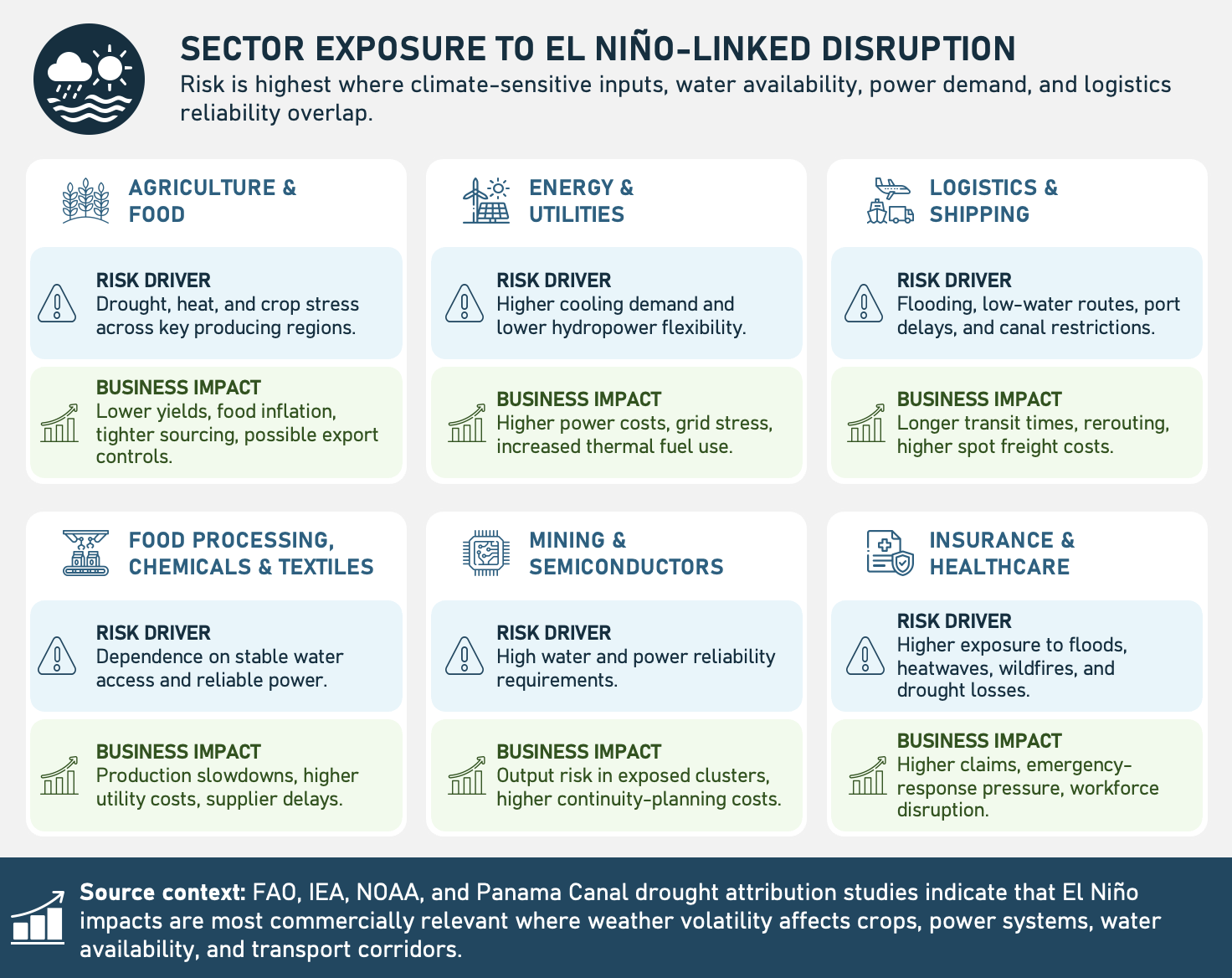
El Niño exposure is highest where climate-sensitive inputs, water requirements, power demand, and logistics dependency overlap.
The most exposed sectors include:
- Agriculture and food
- Energy and utilities
- Logistics and shipping
- Food processing
- Mining
- Chemicals
- Textiles
- Semiconductors
- Insurance
- Healthcare
Conclusion
El Niño should be treated as a forward-looking risk signal for 2026 planning. Its impact can move quickly from weather volatility into food prices, power costs, logistics reliability, and supplier continuity.
Turn risk signals into earlier action
El Niño is one example of how fast-moving external signals can become procurement, logistics, and supplier continuity risks. ID8 Global helps teams connect disruption intelligence with the decisions that keep operations moving.
Book a demo to see how ID8 Global can help your team identify, assess, and act on supply chain risk earlier.